India Part 2 - Exploring the Golden Triangle
Max Baker | NOV 11, 2025
Max Baker | NOV 11, 2025
Our group of amazing yogis parted ways in Rishikesh (read about that here). Some went back home, others continued their adventures around India or South Asia. I had 4 days before I was going to meet back up with our teacher Janet and another group of yogis to go on Pilgrimage in South India.
I decided that I wanted to explore India's "Golden Triangle", which is comprised of the cities of Jaipur, Agra, and Delhi. Luckily for me, 5 other yogi friends had the same idea so we banded together and set off on the next part of our adventure. We took the short flight from Rishikesh and landed in Jaipur late in the evening. Leaving the airport, my first impression of Jaipur, a city of roughly 3 million people, was that it was much more modern feeling than Rishikesh. A lot more lights, taller buildings, paved roads, a totally different vibe. Jaipur is the capital city of the Indian state of Rajasthan, and is known as the "Pink City" due to the Old Town buildings being almost entirely pink and terracotta colored. The modern vibe seemed to be more around the airport, because the Old City of Jaipur felt unique and historic.
The next morning, we left early for a full day of exploration around Jaipur. First we went to Amer Fort which is a UNESCO World Heritage Site that was built in 1592. We stopped outside the fort at a stepwell, which is a large, square-shaped open well with steps on all sides down to the water. This one was built in the 16th century, and is fascinating because it almost looks maze-like.
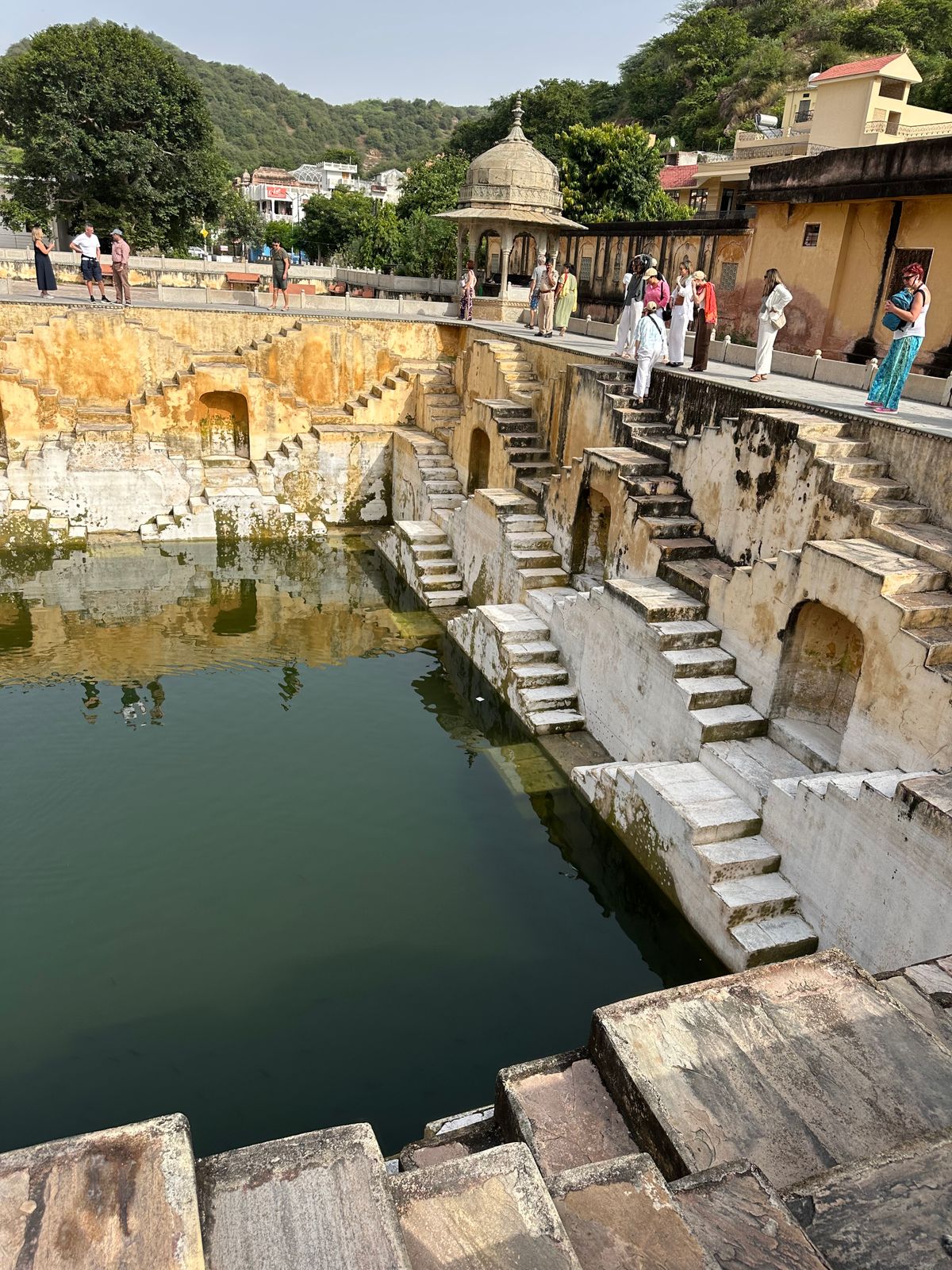 Panna Meena Ka Kund stepwell in Amer, Rajasthan.
Walking into the Amer Fort, we entered the first and main courtyard as drums thundered overhead. This courtyard was originally for military training and parades. We saw some tourists riding elephants here (I skipped this part because I felt bad for the poor elephants - definitely not vegan!).
 Part of the courtyard in the Amer Fort.
We entered into the Shila Devi Temple, which is a small Durga / Kali Temple inside the fort. We removed our shoes and entered into the beautiful and ornate carved-marble temple. Devotees come to pay their respects to the Goddess Kali / Durga in her form as Shila Devi. They ring a large and very loud bell, almost like pressing a doorbell to let the Divine know "I'm here!". We were told after we left the temple that daily goat sacrifices were performed here (also not vegan!) until the practice was banned in 1980.
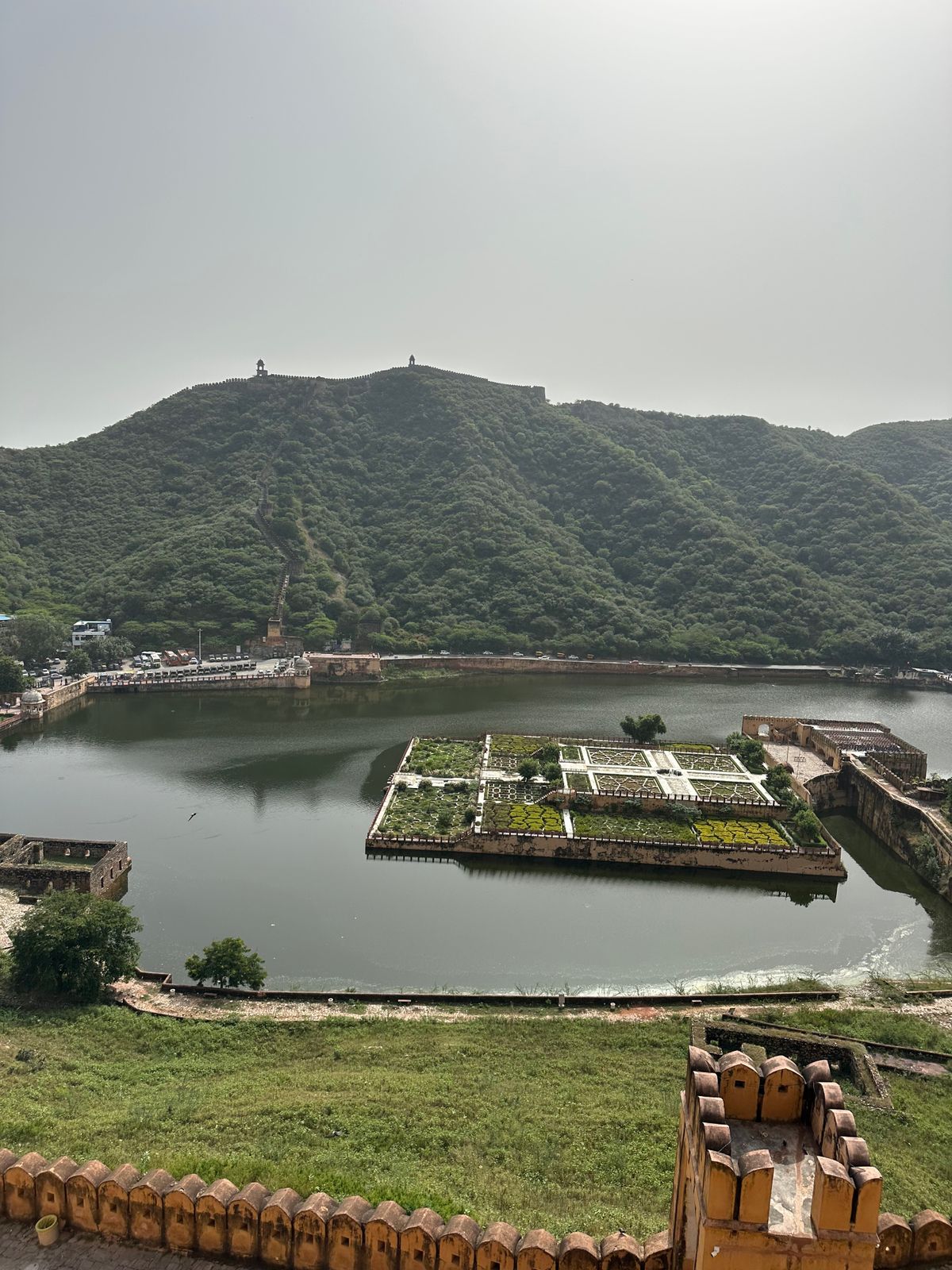 View of the lake and gardens in front of the Amer Fort. Notice the fortress walls on the hilltop in the distance.
We wandered further into the fort to see the beautiful Ganesh Gate and the ornate Mirror Palace. The Sheesh Mahal, or Mirror Palace, is covered in precious stones and mirrors that can reflect candlelight to make the entire space magically sparkle.
 Ganesh Gate inside Amer Fort. You can see Ganesh above the door. At the top of the building there are marble lattice windows that royal women would use to keep an eye on things below, without being seen.
 A small section of the Mirror Palace.
 Check out the details on the ceiling of the Mirror Palace.
We left the Amer Fort and headed to the Jal Mahal, or Water Palace. Built in 1699, only one floor is visible above the water, but there are 4 more floors submerged below the water.
 The Water Palace. There are 4 more floors hidden below the surface of the lake!
Next, we visited a block print shop where artisans created beautiful designs by stamping different colors onto fabric. Jaipur is known for its block printing artists and makers.
A short clip of the block printing process.
Jaipur is also known as as "Emerald City" because it is a hub for cutting colored gemstones such as emeralds and crafting them into beautiful jewelry. We visited a gem-cutting operation, where men hand-cut and gemstones right in front of us.
A short clip of a man grinding and cutting gemstones. The blue/green dust on his fingers is from sapphires and emeralds. The grinding wheel has an unpleasant high-pitched noise, so maybe lower the volume before you watch this one.
We did a tour of another UNESCO World Heritage Site: Jantar Mantar - an amazing piece of astronomy and history. It is an observatory that was built in 1734 and features 19 astronomical instruments (that are massive structures) that can tell the time down to the second, map the stars, tell the horoscope sign of a baby born at any time, and more. One of my favorite movies is The Fall (2006), which has multiple scenes filmed here.
 World's largest sundial in Jantar Mantar. The shadow from the building on the left falls on the curved structure on the right, showing the precise time.
We went on to Jaipur City Palace in the Old City. If you do a quick google search of Jaipur, this is the amazing building that pops up first in the search results. Built in 1732, this pink palace is incredible, unique, and ornate. We took a rickshaw ride around the palace, through the chaos of the Old City.
 Me standing in front of the Lotus Door in Jaipur City Palace.
 Sarvato Bhadra, where the ruler would hold private audience with guests.
A short clip of the outside of the stunning Jaipur City Palace, taken from the chaos of a Jaipur city street.
I was very excited to visit Govind Devji Krishna Temple, which is part of the City Palace complex, because of my love for Shri Krishna. Krishna is sometimes referred to as the "God of Love" because the thing that he cares most about is exchanging love. If you've ever taken one of my yoga classes, then you know I like to add in some bits of wisdom from The Bhagavad Gita, which is a foundational text of yoga philosophy, and was spoken by Shri Krishna. (Maybe at some point, I'll write another blog post focusing more on Krishna and the Bhagavad Gita). So to visit Govind Devji Temple was a very special experience for me.
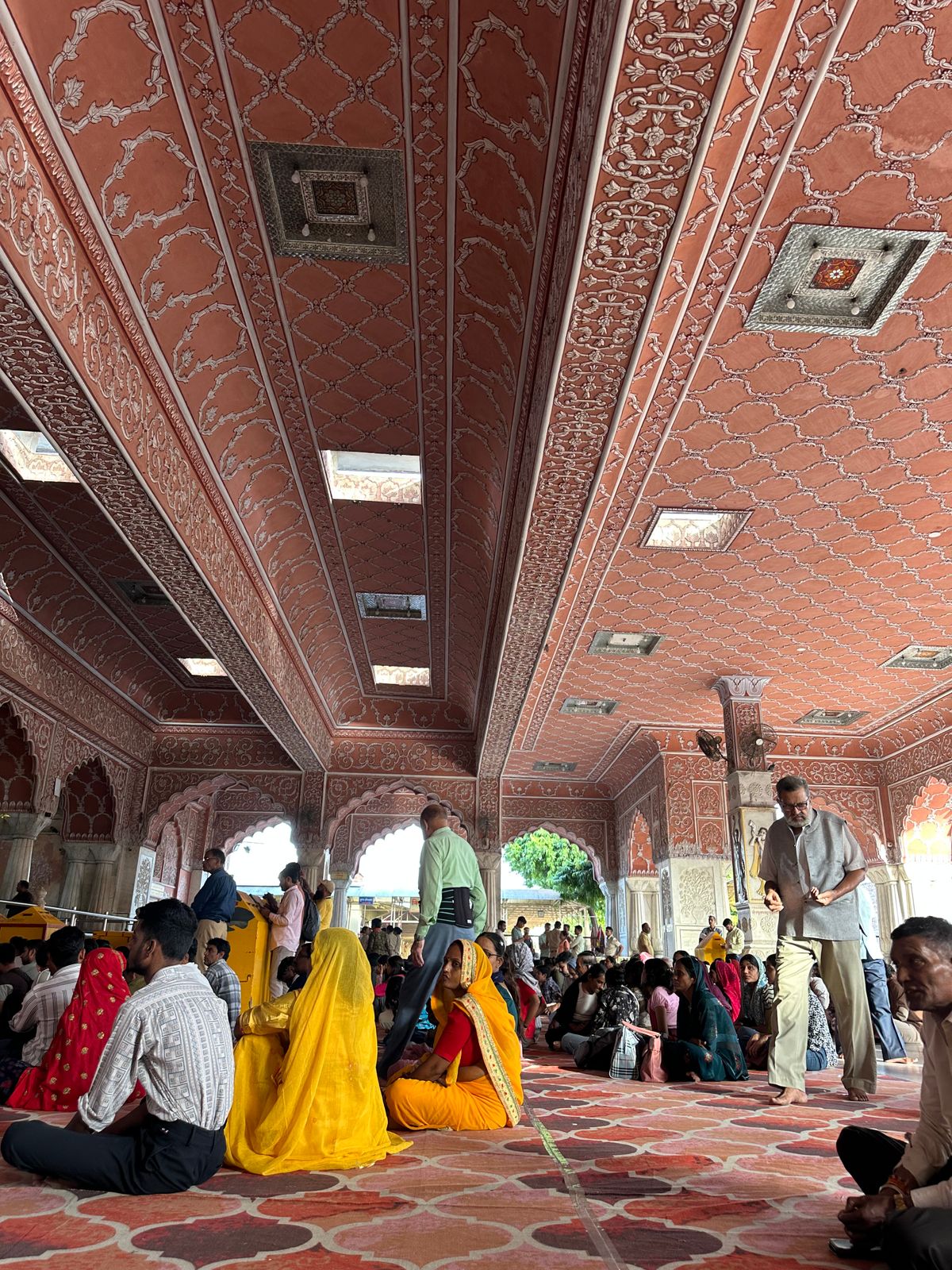 A portion of the crowd, waiting for darshan in Govind Devji Temple.
The temple features the deities Krishna and his eternal consort Radha. These idols were originally held in Vrindavan, where Krishna grew up, but were moved to Jaipur when Vrindavan was under attack by Mughals in 1670. The temple is in the Guinness Book of World Records for being the world's widest concrete building, and can accommodate 5,000 devotees at any given time.
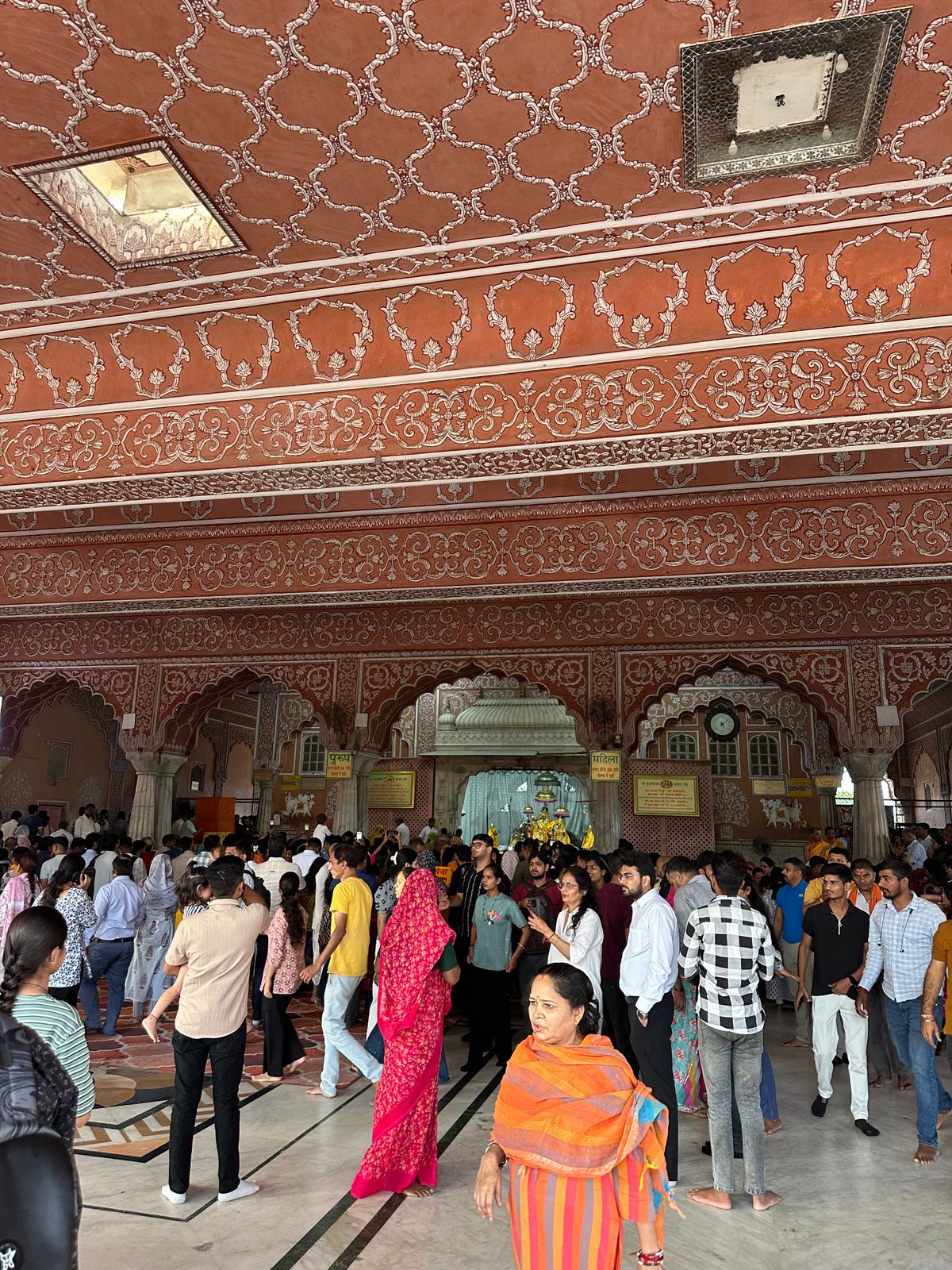 Devotees gather at Govind Devji Krishna Temple, in Jaipur.
We entered the temple to see hundreds of people sitting on the floor, waiting for their opportunity for darshan (literally divine sight, to view the deity). As darshan time approached, people began to stand and the anticipation was palpable. The atmosphere was similar to being at a big rock concert, the crowd anticipating the main act walking on stage, the energy growing more electric as as the moment drew nearer. Suddenly, a large curtain opened on stage and the crowd pressed forward, eager to see Krishna and Radha. Priests lit ritual fires in offering to the deities, while other priests loudly and rhythmically banged large bells with hammers, or threw holy water into the crowd. The crowd began shouting, chanting, and singing. The spiritually charged atmosphere was intense and totally new for me.
A short clip captures some of the energy of darshan in Govind Devji Temple. Krishna and Radha deities are on a raised platform, dressed in yellow.
The next morning we started a 6-hour drive to Agra, a city in the state of Uttar Pradesh with a population of roughly 2 million people that sits on the banks of the sacred Yamuna river. The drive was an interesting journey in and of itself. We got to drive past many villages, towns, and rural areas. We saw men standing on the outside of vehicles, holding on for dear life. We saw scooters and cars driving the wrong way down the highway. We saw temples big and small along the sides of the road. We witnessed a herd of camels taking over the highway.
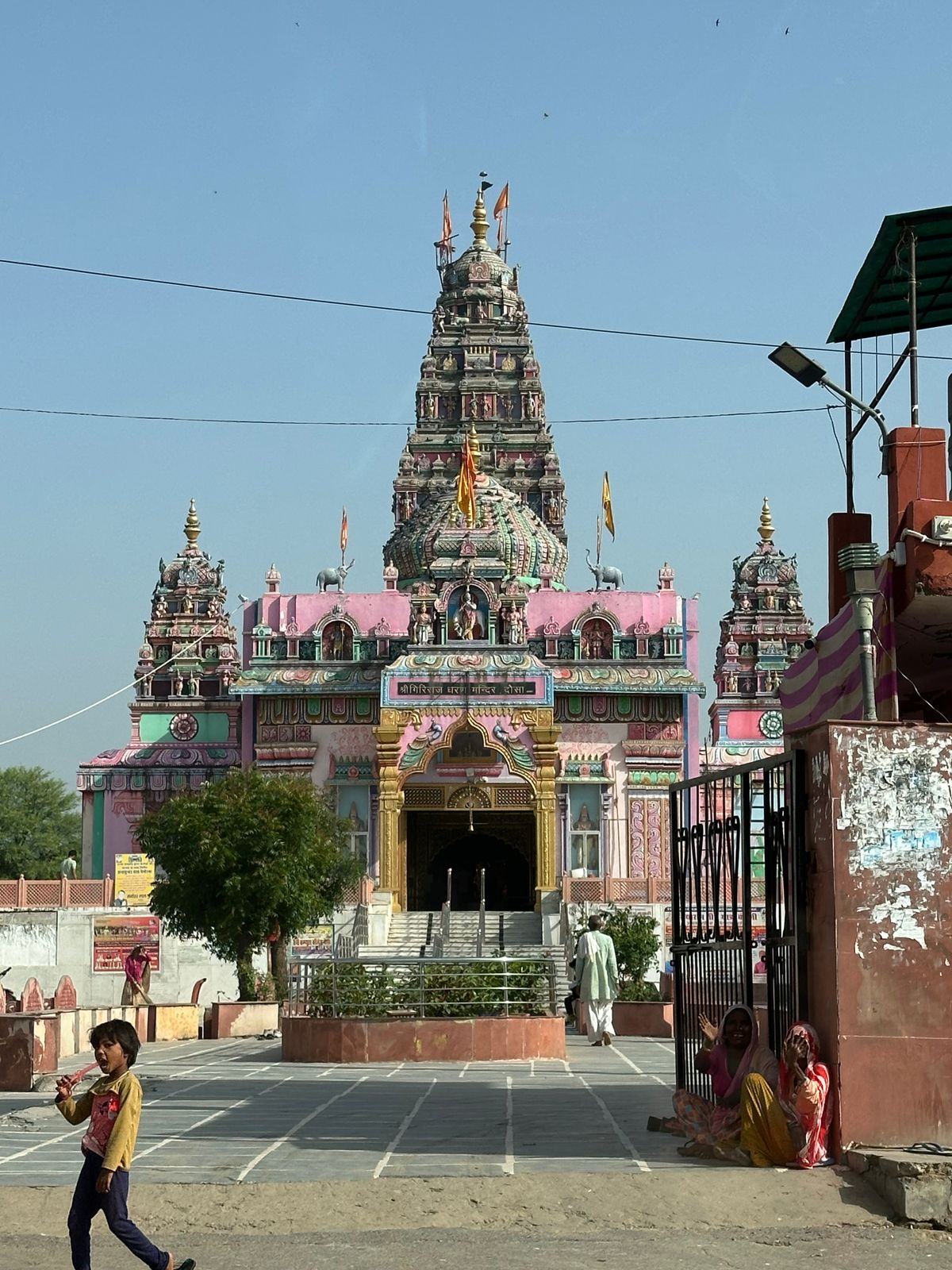 A Krishna temple on the side of the road in rural India. Little guy on the left seems pretty stoked about his snack.
 Camel traffic jam on the highway to Agra.
We made a stop at Fatepur Sikri, another UNESCO World Heritage Site, which is a walled city and fortress that was completed by Mughul Emperor Akbar in 1571. The history of Akbar The Great is fascinating - (he liked to train cheetahs!) and he attempted to create his own religion called Din-i Ilahi that was a fusion of Islam, Hinduism, Buddhism, Christianity, and other practices such as yoga and vegetarianism.
 Me outside of Diwan-i-Khas, or "Hall of Private Audience" inside Fatepur Sikri.
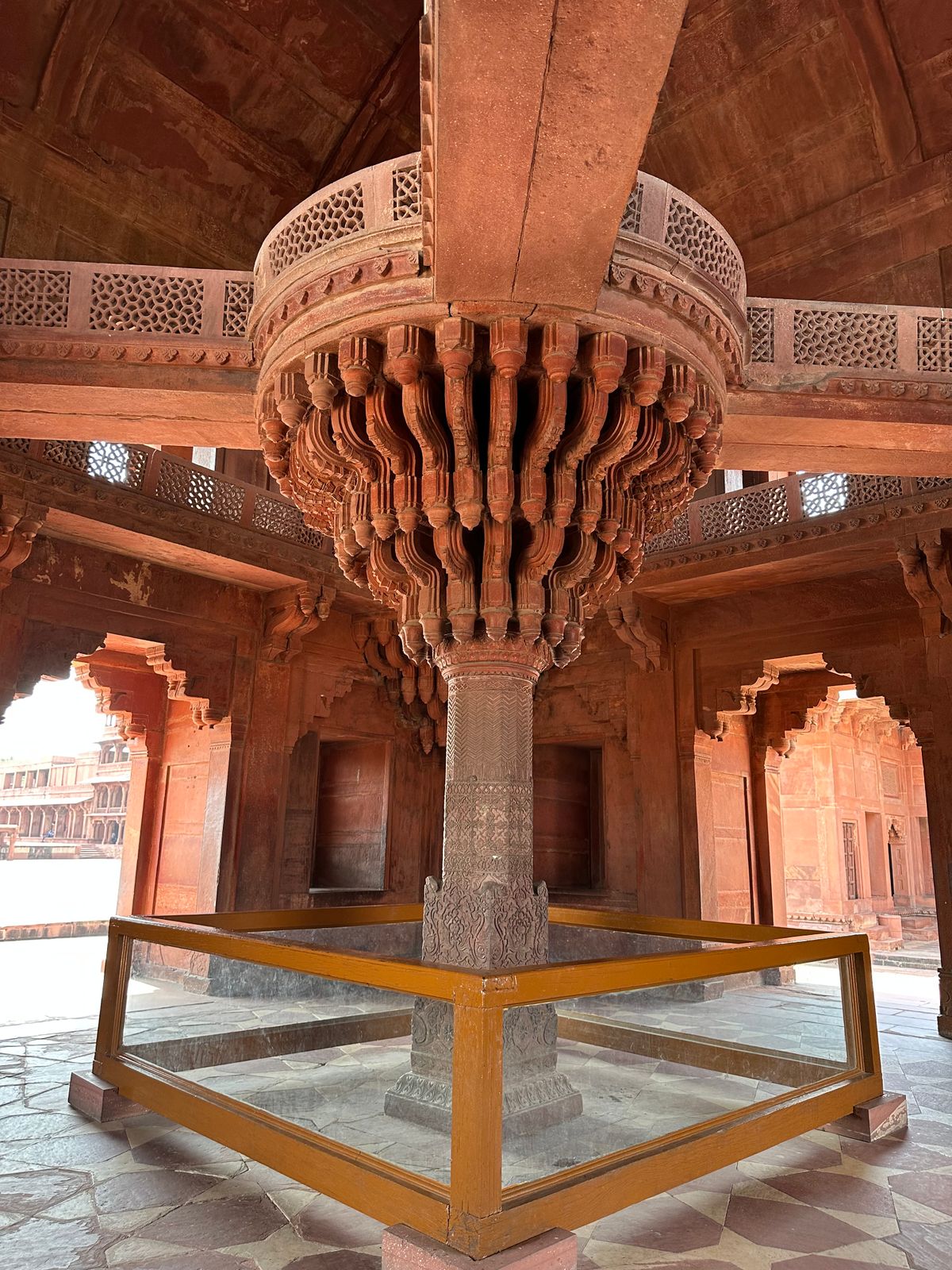 Inside of Diwan-i-Khas. Emperor Akbar stood on top of the central column and had representatives from different religions discuss their faiths. The ornate carvings in the columns and walls are inspired by symbols of many different faiths.
Inside Fatepur Sikri is the Jama Mosque, a beautiful 16th century Sufi Mosque that is still used as a place of worship today. We waited for prayer time to end before we went inside the mosque. Akbar built this mosque to honor his spiritual advisor, a Sufi saint named Sheikh Salim Chishti.
 Locals leaving the Jama Mosque after prayer.
 Inside the beautiful Jama Mosque in Fatepur Sikri.
We then headed towards the Agra Fort, which is a walled city and fortress that was ruled by another Mughal emperor named Shah Jahan the Magnificent. The fort is yet another UNESCO World Heritage Site, with rich history and massive and ornate palace features.
 A stunning and intricately designed hall inside the Agra Fort.
The next morning, we did a sunrise visit to the Taj Mahal. This world-famous building is (you guessed it) another UNESCO World Heritage Site, and an amazing love story. Shah Jahan the Magnificent built the Taj Mahal as a moment for his wife Mumtaz Mahal as symbol of his deep love for her. I had obviously seen pictures of the Taj Mahal before and knew it would be impressive, but I was surprised at how awe-struck I was by it. It is breathtakingly beautiful. It is obviously a big tourist attraction, but its primary use is as a mausoleum.
A short clip of the Taj Mahal. View from the side, just after sunrise.
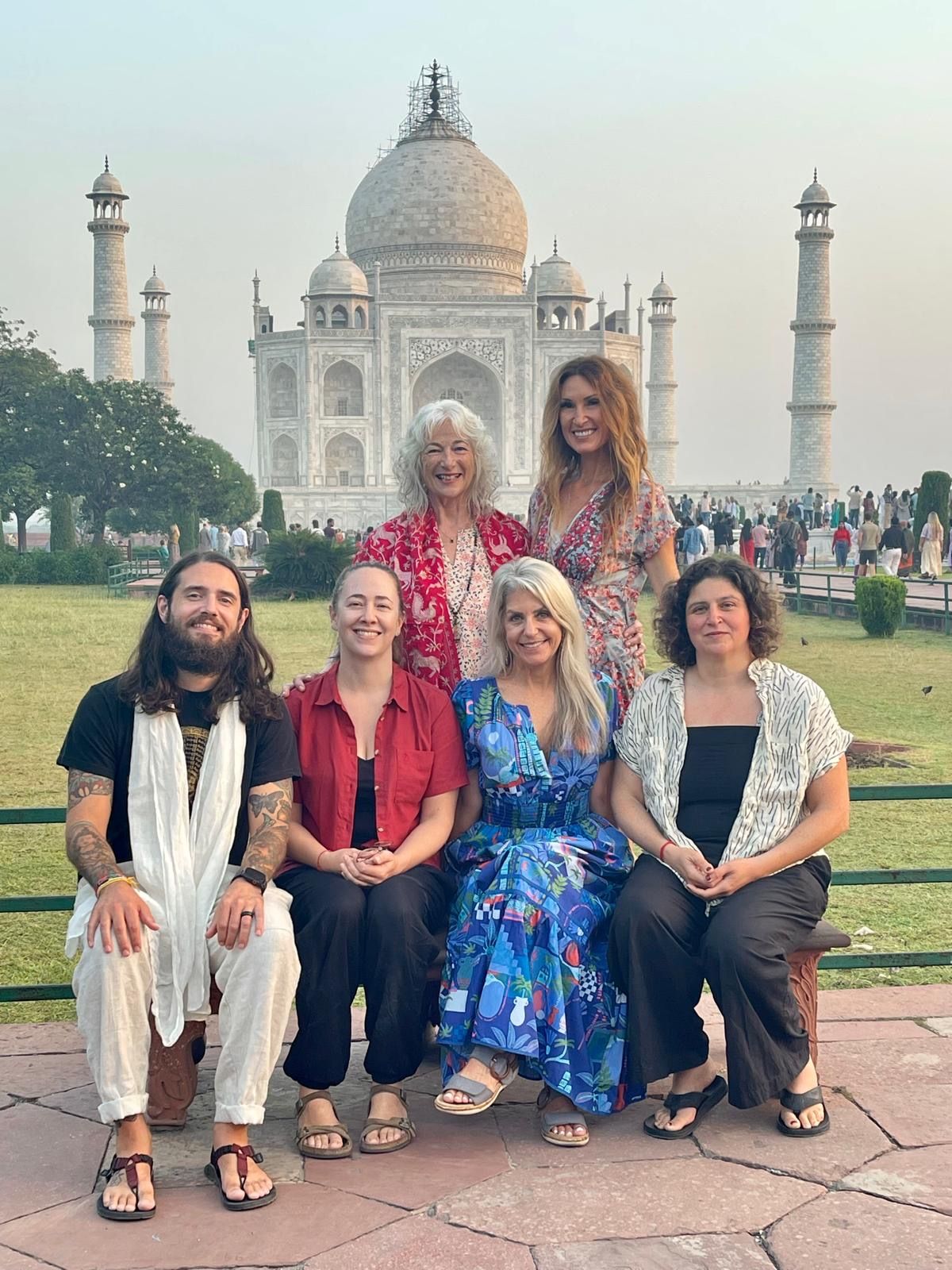 Our Golden Triangle Yogi Crew. (from left: me, Dawn, Heather, Melanie, Kyla, and Mania)
Later in his life, it is rumored that Shah Jahan the Magnificent wanted to build a "Black Taj Mahal" directly across the river from the Taj Mahal as a monument to himself, but his son didn't want him to bankrupt the empire and imprisoned him in the Agra Fort until his death.
After our sunrise visit to the Taj Mahal, we took what was supposed to be a 4 hour drive to Delhi. That turned into a 6+ hour drive as we hit the insanity of Delhi traffic. The highway had 3 painted lanes for traffic, but there were actually five lanes of cars and tuk-tuks, with scooters flowing in between all the cars. The painted lanes are very loose suggestions. Our driver told us that you only need three things for driving in India: a good horn, good brakes, and good luck.
A short clip of the chaos of Delhi traffic, featuring scooters, tuk-tuks, and lots of birds.
We eventually made it to our hotel in Delhi, where we were looking forward to a chill and quiet evening after all the stimulation from our adventures over the last 3 days. Little did we know that our hotel was hosting Fashion Week there, so the lobby was packed with very fashionably dressed young people and had loud thumping music. It felt almost like we entered a hotel in Las Vegas.
The next morning we flew south to Chennai to begin the Sacred India Pilgrimage through the Indian state of Tamil Nadu. To follow along for the final part of the adventure, stay tuned for Part 3...
Want to find out if private sessions will work for you? Want to explore working with me in another capacity? Book a free consultation call with me. I offer private sessions both online and in my home studio in Raleigh, NC.
Max Baker | NOV 11, 2025
Share this blog post
 OfferingTree