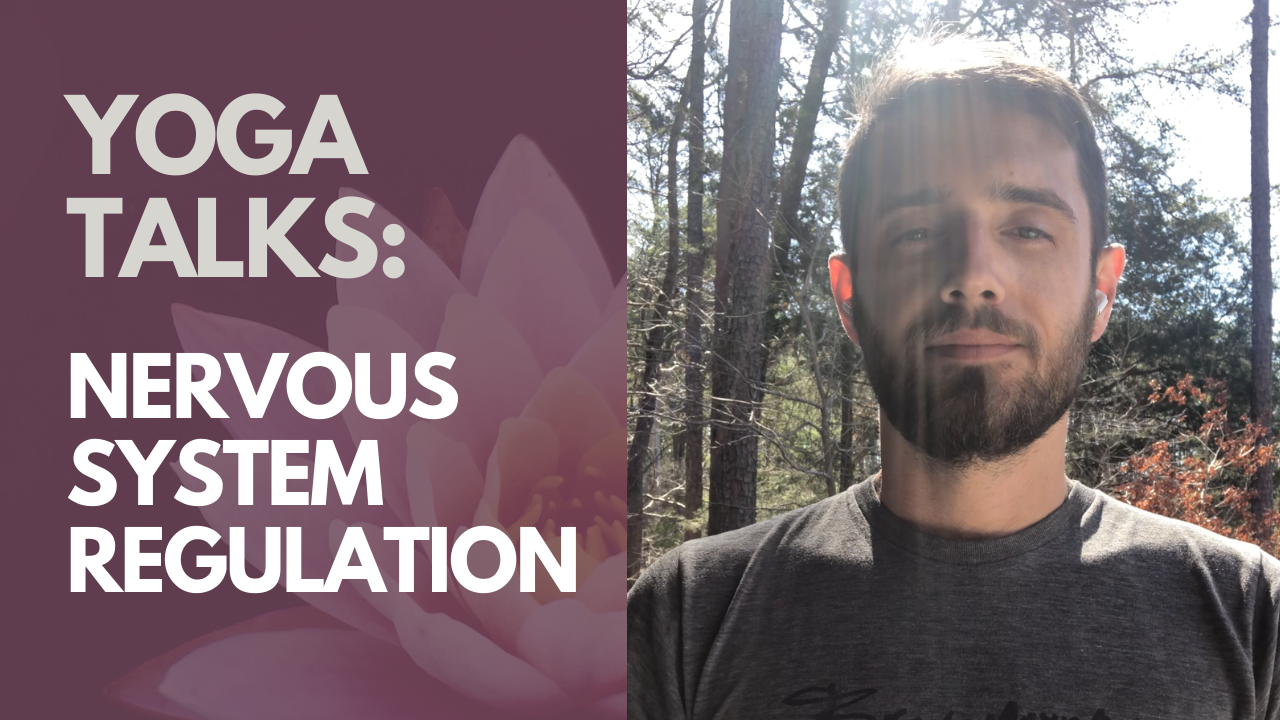
Yoga Talks: Nervous System Regulation
Max Baker | JUN 7, 2022
nervous system
regulation
upregulation
downregulation
pranayama
stress
meditation
yoga
health
disease
interoception
yogatalks
Max Baker | JUN 7, 2022
Did you know that 77% of people experience stress that affects their physical health? This is according to the American Institute of Stress.
Studies have shown that stress worsens or increases the risk of conditions like obesity, heart disease, Alzheimer's disease, diabetes, depression, gastrointestinal problems, and asthma. (source)
Just do a quick google search of studies on disease and stress, and you will see what I mean.
The nervous system plays a direct role in your body’s response to stress. The problem is that most people don’t know how to control their nervous systems. If I asked you to manipulate your nervous system, how would you do it? It is not under our direct volitional control in the same way that other body parts are. For example, if I asked you to manipulate your hand or your leg, you could easily wiggle your fingers around, squeeze your fist, or bend your leg. But the nervous system is a bit more subtle than that.
Let’s use the example of a see-saw, which are common on many playgrounds. If two kids are playing, they may not be able to lift each other in the air using only their arms. However, using the principle of leverage, they can use the see-saw to easily lift each other up. The see-saw gives leverage that makes the work much easier.
The breath is a tool that we can use to manipulate our nervous system. It is like the see-saw in this example. You cannot directly manipulate your nervous system, however using the breath to gain leverage, you can influence your nervous system. The breath is connected to heart rate, which is connected to levels of arousal and to the state of your nervous system.
Upregulation means there’s an increased firing of neurons along a nerve pathway, making your nervous system more active. It is like pressing the gas pedal on your nervous system. Downregulation is the opposite and brings you more into a state of calm. It is like pressing the brake on your nervous system.
Let’s say today you are having a bad day. You’re frustrated, maybe you didn’t sleep well, and your boss says a rude comment to you or someone cuts you off on the drive to work. For most people, in this situation their heart rate may spike, the pace of their breath may get quicker and be more shallow, and they may have a spike of adrenaline or cortisol. Your nervous system is taking in data about the situation and reacting accordingly: it wants to protect you from perceived danger.
In this situation, you’d most likely want to down-regulate your nervous system using one of the many yogic breathing techniques to slow down your breathing, slow down your heart rate, and bring yourself back to a state of calm balance before you continue with the rest of your day.
This is a great question! Interoception is the perception of sensations from inside the body. It is crucial to develop the skill of interoception so that you can become attuned to and aware of your inner state. You can’t regulate your nervous system if you aren’t even aware of what state your nervous system is in in the first place! The practice of yoga is an excellent way to develop this skill because it focuses so much on awareness of breath and body - somatic awareness.
So, do you have some tools of your own that you can use to regulate your nervous system and its response to stress?
If not, it may be a good idea to build a “toolbox” of techniques to help you manage when times are stressful.
If you are interested in learning more about how the practice of yoga can help you to regulate your nervous system, please consider joining my mailing list by hitting the subscribe button at the top of this page. I offer online and in-person classes as well as private sessions.

Max Baker is a certified Yoga Teacher based in Raleigh, NC whose passion is helping people find the tools and the confidence to reconnect with the most authentic version of themselves. He does this through his website, online courses, memberships, and in-person classes.
Max Baker | JUN 7, 2022
Share this blog post
 OfferingTree