India Part 3 - Sacred Pilgrimage
Max Baker | DEC 29, 2025
Max Baker | DEC 29, 2025
A bit sleep deprived, we arrived in Chennai to begin our pilgrimage.
Chennai is a large city in Southern India, with a population for the metropolitan area around 12 million people. Chennai is the capital of the Indian state of Tamil Nadu. Here, Tamil is the official language which is totally different from Hindi, which was spoken in the previous cities we had visited. The Tamil language is ancient - it is one of the longest-surviving classical languages in the world and has been spoken since at least 300 BCE. It also has its own alphabet that is totally different from the Devanagari script of Hindi and Sanskrit.
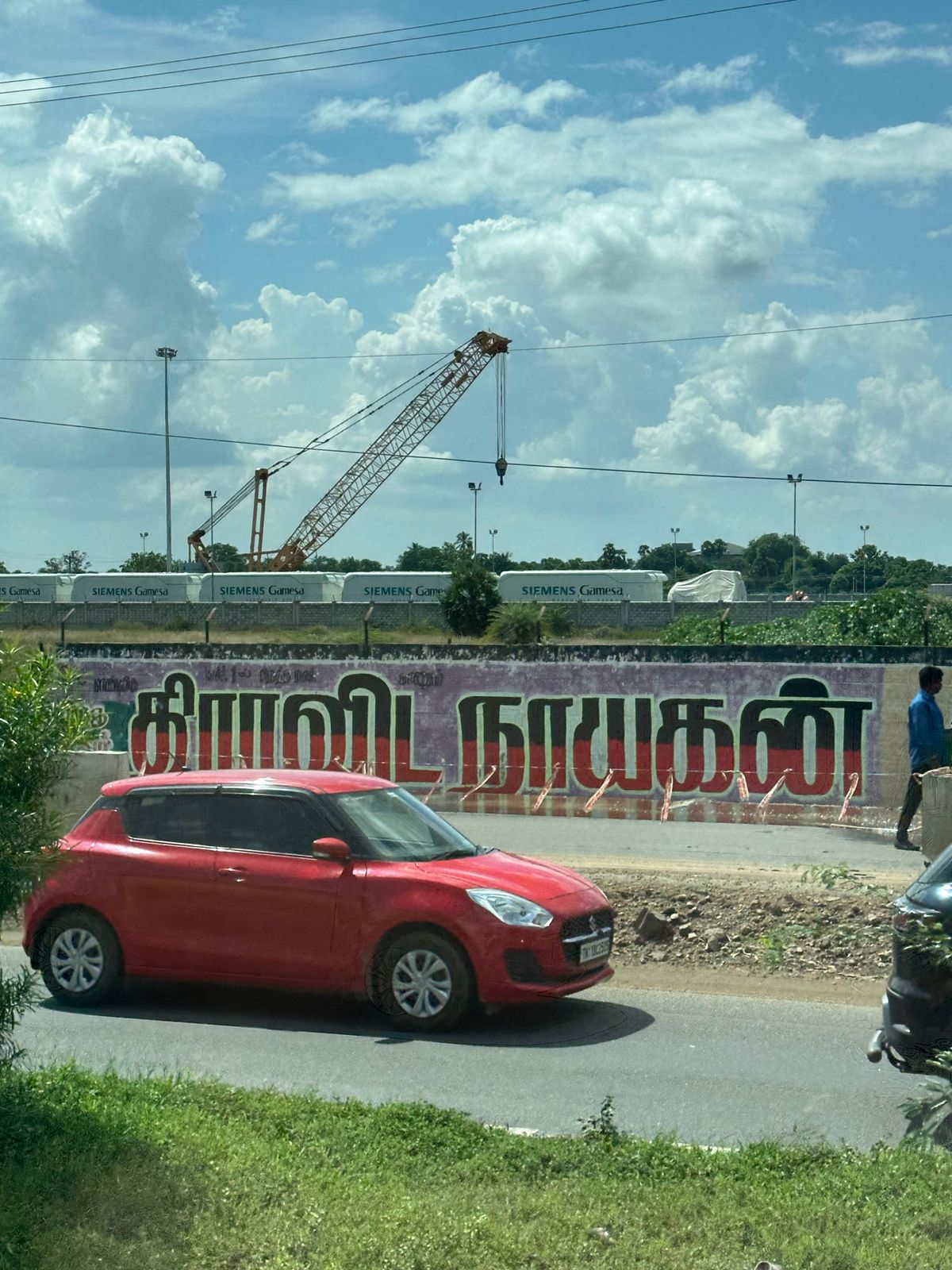
Check out the Tamil script spray-painted on the concrete barrier.
A group of us rode through the large city on the way to our hotel, The Leela Palace, which has to be one of the nicest hotels that I've ever stayed in. The lobby is filled with ornate gold and marble, the air smells of fresh flowers, and staff immediately put beautiful flower garlands around our necks as we arrived.
We were given a little bit of time to get settled before our first meeting as a group. Roughly half of this pilgrimage group was together for the Path of Devotion in Rishikesh (Read Part 1 here), and the other half consisted of brand new faces joining the group. It was so nice to reconnect with the familiar faces from Rishikesh. Even though it had only been four days since we had seen each other, everyone had just had grand adventures. I had just been touring the Golden Triangle with a small group of yogis (Read Part 2 here). I found out that one small group had travelled together to Dharamshala, high up in the Himalayas where the Dalai Lama lives, and meditated and chanted with the monks and even met famous author and teacher Jack Kornfield in their hotel. One young woman travelled alone to Varanasi, the spiritually charged "City of Death" where people come to die and be burned in the cremation ghats. Another woman traveled to meet up with her new Indian lover, and was beaming with the sparkle of new love.
The new additions to our group of yogis were also very interesting people: there was a somatic therapist from the UK, a yoga studio owner from South Africa, a sustainable fashion industry consultant from California, and a vegan couple traveling the world together for five months had just flown in from Sri Lanka, among many others.
We had dinner together at The Leela Palace Hotel, which was a massive multi-cuisine buffet with many vegan options.
The next morning, we met outside at 6am for meditation, chanting, and morning asana practice. Despite it being 6am, the heat and humidity were incredible. The squawking of the birds in the trees around us was constant and very loud.
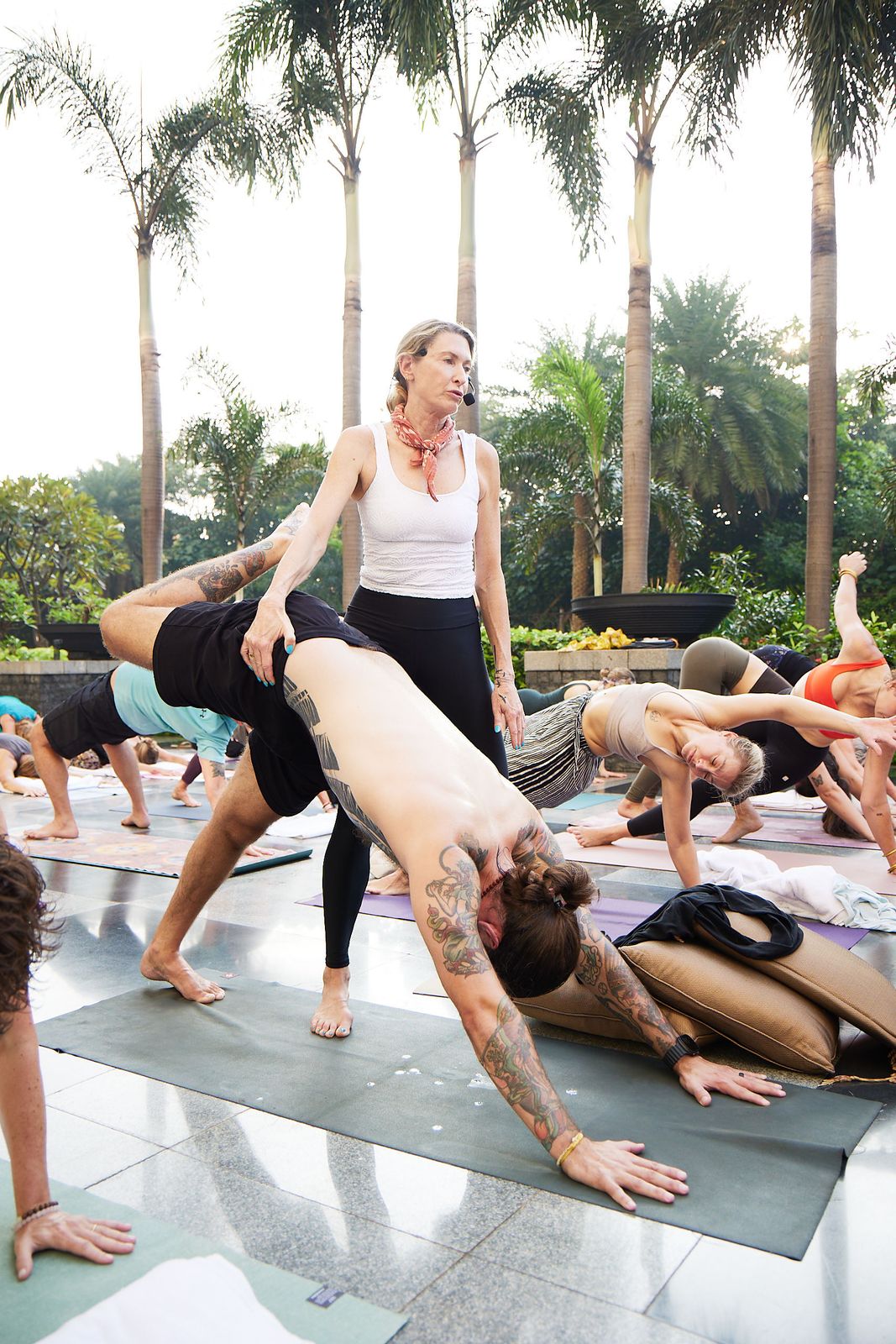
Our teacher Janet giving me a hands-on assist during our outdoor morning practice in Chennai (photo by Sara Davis).

Another shot from our morning practice in Chennai (photo by Sara Davis).
After morning practice, we were brought into the city to shop for traditional clothing that we needed for some of the temples we were going to visit. For the women, this meant saris. For the men, it was kurtas (which are like long button up shirts) and dhotis (which are kind of like cloth wrapped around the legs). The shopping experience was chaotic - you had to go to three different counters just to pay for your clothing. I had fun trying on lots of different Indian clothing.
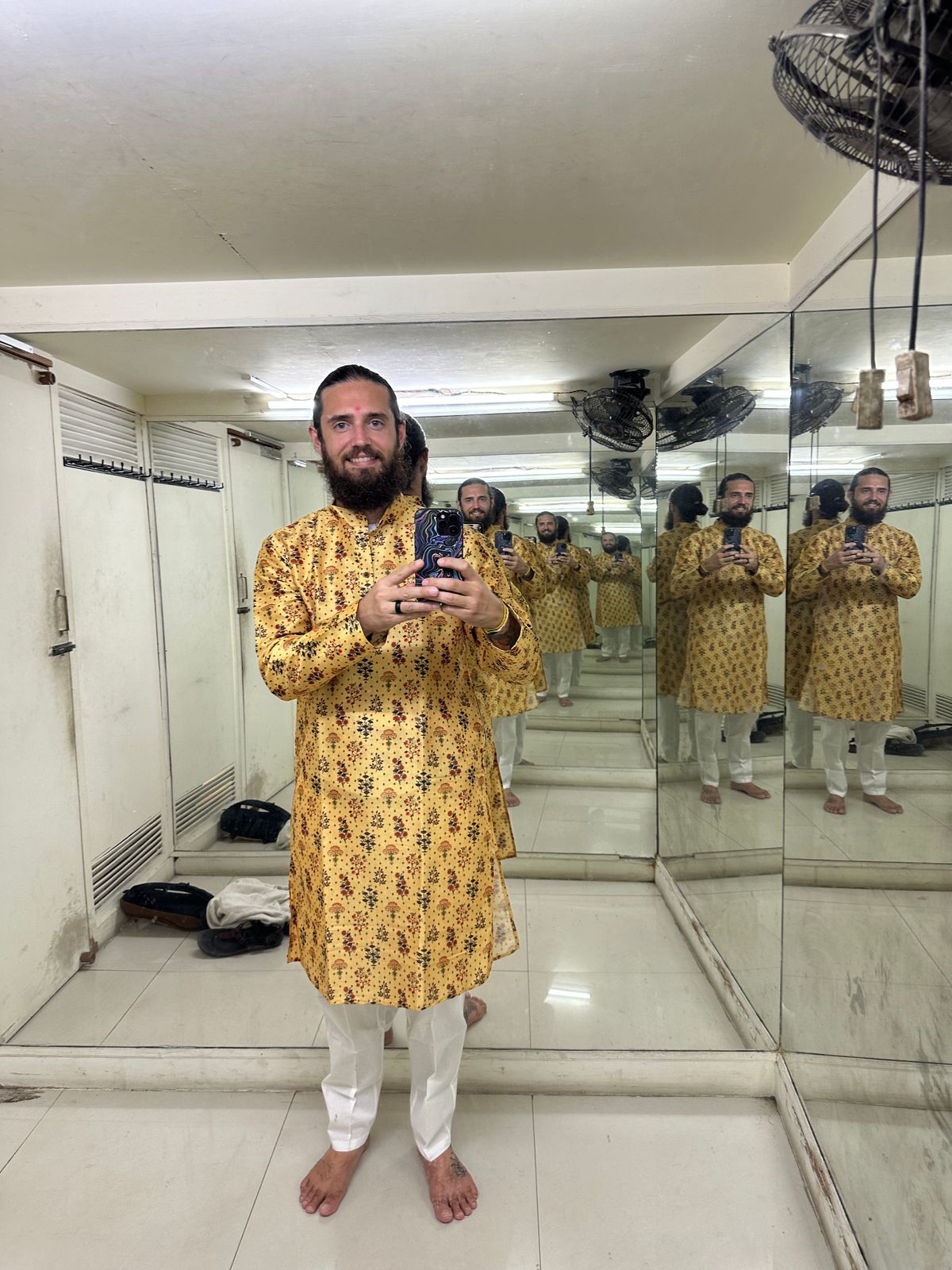
Trying on traditional Indian clothing. The long shirt is called a Kurta.
We met back together in the evening for more chanting, a story with Shiva Kumar, and some discussion around what the next several days would look like.
The next day, we left Chennai and took a roughly 4 hour bus ride to Tiruvannamalai. We stopped about 90 minutes into the trip to check out Mahabalipuram, a UNESCO World Heritage site with collection of of over 40 monuments. There are huge 7th century temples carved directly out of massive rocks. There were seven "shore temples", but six of them have been destroyed by the sea. Only one still remains overlooking the Bay of Bengal. There is also Krishna's butterball, a massive 250 ton boulder that is perched on an incline and is said to be immovable. The English even tried to move the boulder using seven elephants in 1908, and failed. The story of the butter ball is that when Krishna was a little boy, he was playfully mischievous and would often steal butter from his mother. This boulder is said to be a hunk of stolen butter dropped by young Krishna.

Krishna's butterball (yogini for scale).

Our group at the Shore Temple (photo by Sara Davis).
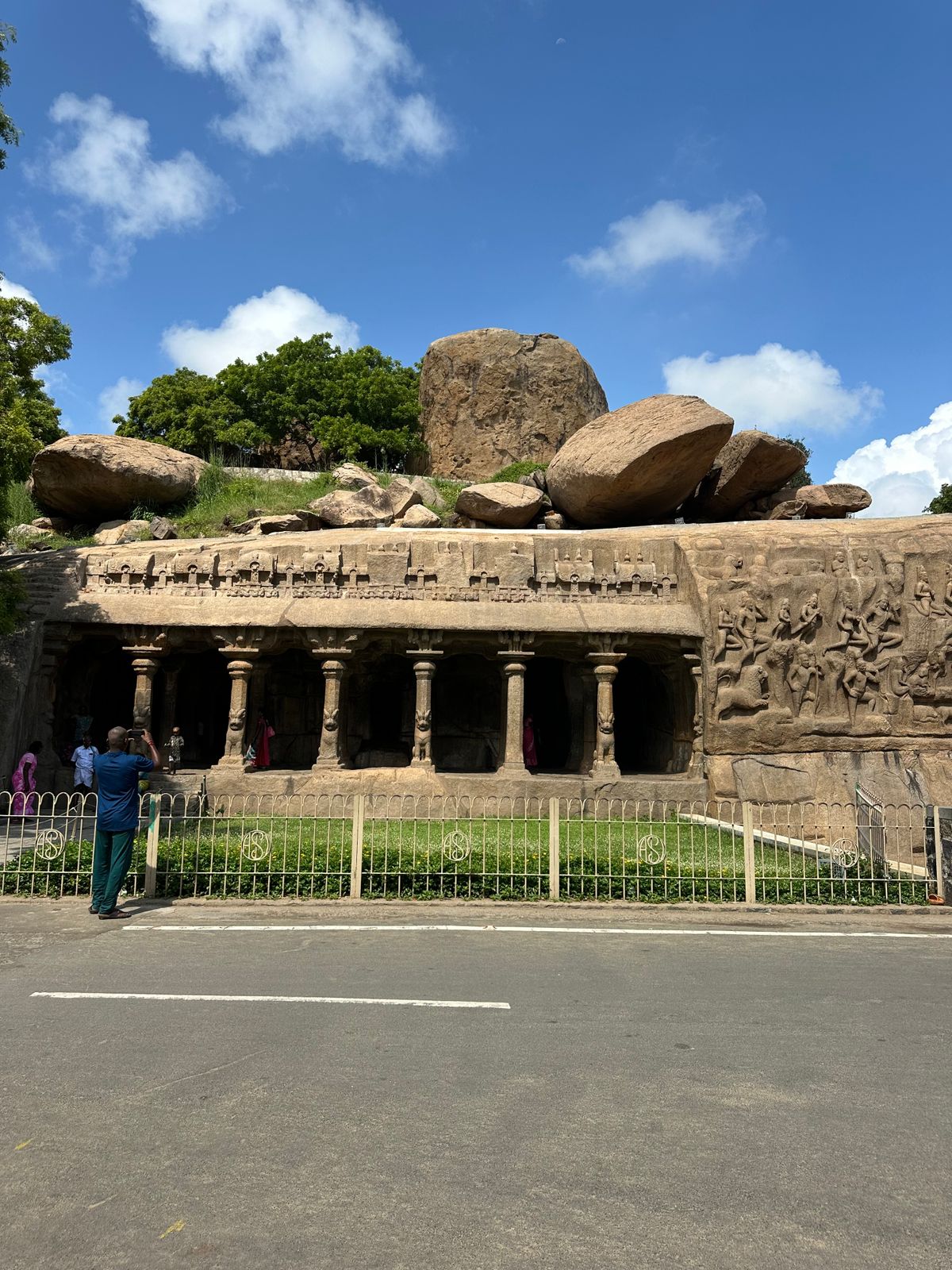
One of the cave temples in Mahabalipuram.
After seeing the temples and heritage sites of Mahabalipuram, we finished our bus ride to Tiruvannamalai, another small city in Southern India. This city is associated with Shiva - one of the major Hindu gods who is associated with pure consciousness, and is known as The Destroyer. He destroys the old to make space for the new. He destroys ignorance by bestowing knowledge. He is also known as Adiyogi, or the first yogi. There is a story that Shiva's wife Parvati once playfully closed his eyes. Although this was only a moment for Shiva, all light in the universe went dark for years. Parvati did penance, and Shiva appeared as a column of fire at the top of Arunachala mountain in order to bring light back to the universe. Arunachala mountain overlooks the city of Tiruvannamalai, and we were on our way there.
A short clip: approaching Arunachala mountain, with Tiruvannamalai visible at the base.
Arunachala mountain looms over the city, and the city's biggest temple consists of multiple pyramid-like structures that can be seen from far away. This temple was built in 9th century CE, so well over 1,000 years old. Because of the association with Shiva and his massive fire column on top of the mountain, this city and temple is associated with the fire element. We were told that pilgrims come to this area to burn away bad karma, and hope for the fire of transformation in their lives.
We made it to our small eco-hotel, with pathways crossing through the jungle property and monkeys playfully roaming the grounds. After getting a few moments to get settled, we headed up to the second floor of the dining hall for an asana practice as a group. We were asked to mentally and spiritually prepare for the next day, as we would be visiting Ramana Maharshi's ashram.

A monkey greets us at reception of our hotel in Tiruvannamalai.
Ramana Maharshi was an influential Indian yogi, sage, and saint who died in 1950. When he was 16 years old, he had the experience that he was dying, so he analyzed what was happening - if he died, what exactly was it that would die and what would survive that death. This was an awakening moment for him, and within six weeks he left home and journeyed to the holy mountain of Arunachala, where he remained a renunciate yogi until his death at the age of 70.
As a young yogi, he meditated so deeply in the temples that he did not notice rodents and ants biting his body. He attracted devotees from around the world, and his teachings were popularized in the west. Sometimes he would answer the questions of his students and devotees, and other times he would simply sit in silence. The core of his teachings is the practice of self-enquiry, which he said was the most efficient way to self-realization. He instructed his students to repeatedly ask the simple question "Who am I?". The answer to this question is not your name, your career, your personality, and so on. He urged his students to reflect on who they were on a deeper level.
We headed to the Ramana Maharshi Ashram the next morning. Walking through the front gates, we were asked to take off our shoes and remain barefoot inside the grounds of the ashram. There were a series of buildings with many monks wandering around. We walked into the first building which was a meditation hall with a large picture of Ramana Maharshi on the wall. We sat on the concrete floor and meditated in front of his picture. Afterwards, we were led through a temple, and then into Ramana Maharshi's samadhi shrine room to receive prasad, before going into another smaller meditation hall to meditate for a few minutes. Afterwards, we gathered as a group to hike up the Arunachala hill. We stopped part way up the hill for sankirtan and to take in the amazing view of the city.
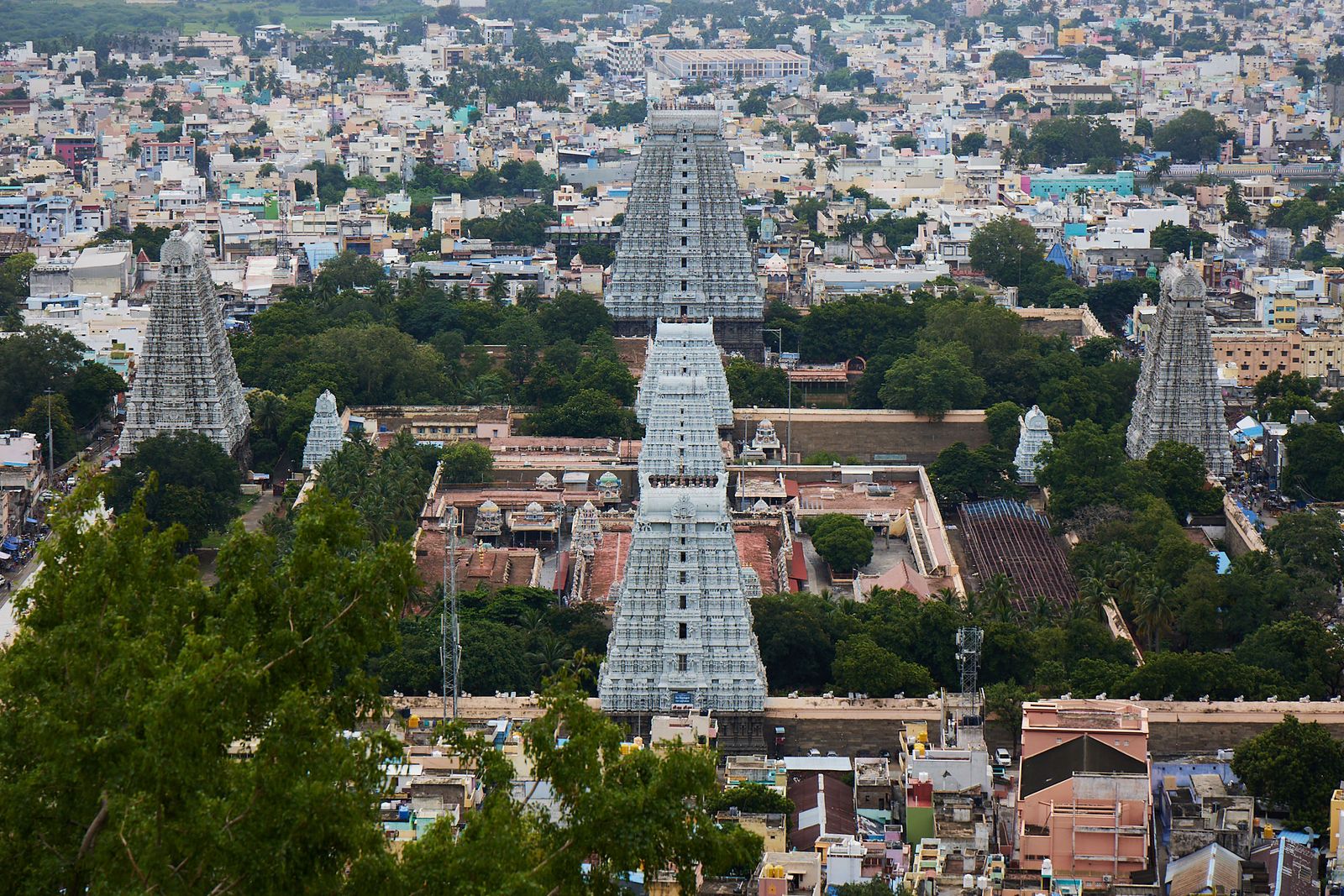
A view from the lookout point, partway up Arunachala mountain. The pyramid-like structures are called gopurams and mark the entrances to Arunachalesvara Temple (photo by Sara Davis).
We hiked further up the hill towards the cave where Ramana Maharshi meditated for many years. The gate was closed, so we waited in front of the gate by singing more kirtan songs, and many locals joined us.

Kirtan (devotional call and response singing/chanting) outside of Ramana Maharshi's cave (photo by Sara Davis).
Once the gate opened, we were invited into the small cave to meditate. I wrote in my journal about this experience: "It was very calming and powerful - easy to drop in there. I asked myself 'who am I?' and tried to experience direct awareness of the self." Once meditation was over, left the cave to prepare for our trip down the mountain. As I was putting my shoes back on, a monkey came out of the trees and grabbed my bag, but I refuse to let go of it and tried to shoo the monkey away, and it hissed at me before finally retreating. Just then, an older couple came walking up the hill and warned us to carry a stick and walk in a group, because the monkeys were getting aggressive and one just bit a young woman deep into her forearm at the lookout point where we stopped earlier.

A family of monkeys on Arunachala mountain. They look cute here, but less cute when they are hissing at you for daring the take your bag back (photo by Sara Davis).
We had a little bit of free time after our hike, so I taught some of my fellow yogis how to juggle back at our hotel. Later that evening, we had a fire-themed asana practice, which was very physically challenging.
The next morning we headed back into town for a 6am visit to the large Arunachalesvara Temple. This is an ancient, 9th century CE Shiva temple. The temple has four massive gopurams, which are ornate monumental entrance towers, and the tallest one is well over 200 feet high. We wandered through the city to reach the front gate.

Approaching the East Gopuram tower of Arunachalesvara Temple.
A short clip: looking up from the base of the East gopuram.
The temple is one of the Pancha Bhuta Sthalams, which are five major Shiva temples, each representing a manifestation of one of the elements. This temple is the Fire Temple. It is a massive complex in the center of town, with the mountain looming overhead. There are many structures and shrines within the temple. We went through several of them, taking darshan (or "divine sight") at the various shrines. When it was time to go into the main temple, we lined up inside what felt like gates for cattle, and stood in line to get in. The temple was packed with locals waiting to get their turn to catch a glimpse of the Shiva deity. When I finally got to the front, the priest put some deep red kumkum powder on my forehead, said a mantra, and pushed me through to take darshan. The deity was visible down a short hall, covered in flower garlands, behind the haze of incense smoke. Before I really knew what was going on, my turn was over and the next person in line was moved to the front for their turn.
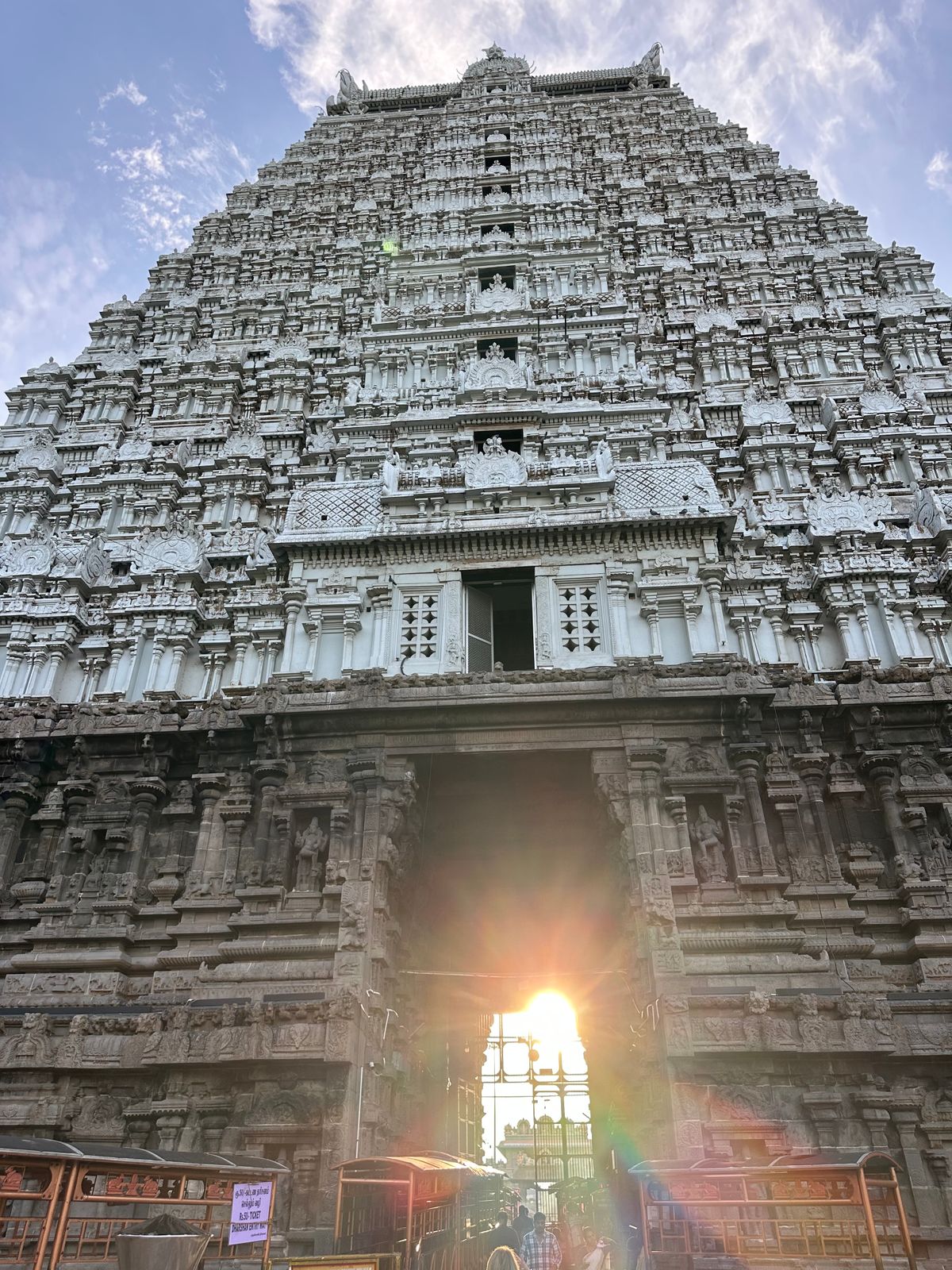
Sunrise peaking through the Eastern gate. This is a view from inside the temple complex.
Once we left the temple, we gathered together on the street to figure out the way back. As we stood there, I was approached by a bunch of local young men asking to take selfies with me. They lined up and each wanted their own selfie with me. This had been happening somewhat regularly throughout the trip, but I never thought to ask to take my own selfie with them. This time I did, and captured the below pic. I'm still not sure why so many people wanted a selfie with a random stranger. I was not the only one in our group that this happened to - almost everyone was approached at least once to get a selfie with a stranger.
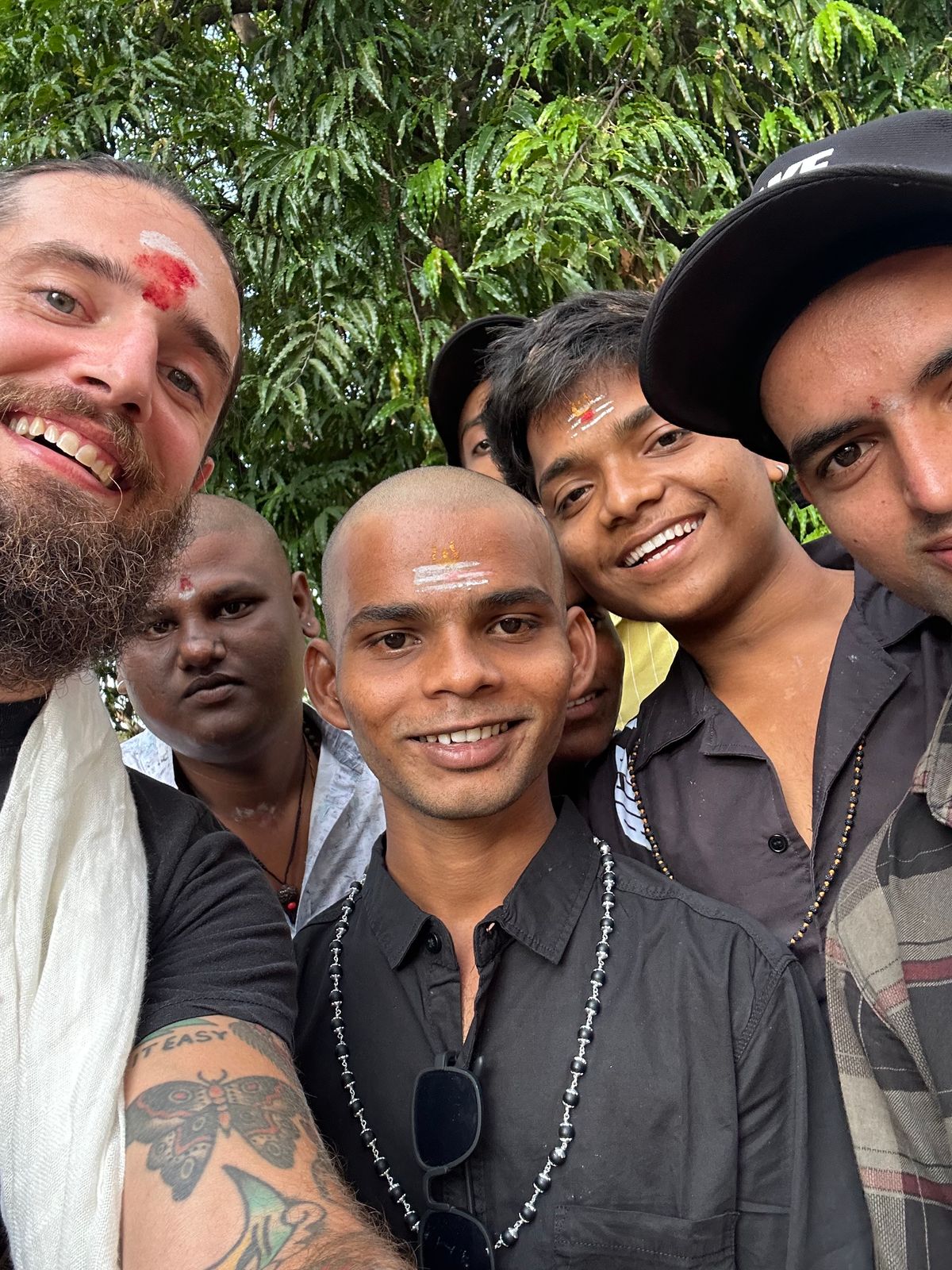
Group selfie with some of the locals.
After our temple visit, we returned back to our hotel. Professional photographer and yogini Sara Davis traveled with our group for our entire journey in India, and I was lucky to be able to schedule a photo shoot with her. Check out Sara's website here.

From my photoshoot with Sara Davis.
After the photoshoot, we began prepping for another big yantra and puja ceremony. This time, I was asked to be the assistant to the pujari, which was a great honor for me and meant that I needed to do extra work to prepare. I began work at 10:30am, pulling petals off of flowers and carefully placing colored powders into an elaborate yantra mandala pattern on the floor. This was very fun work, but also hours of kneeling on the floor to fill in the pattern correctly. I worked with a small team until just before 5pm to get the yantra ready.
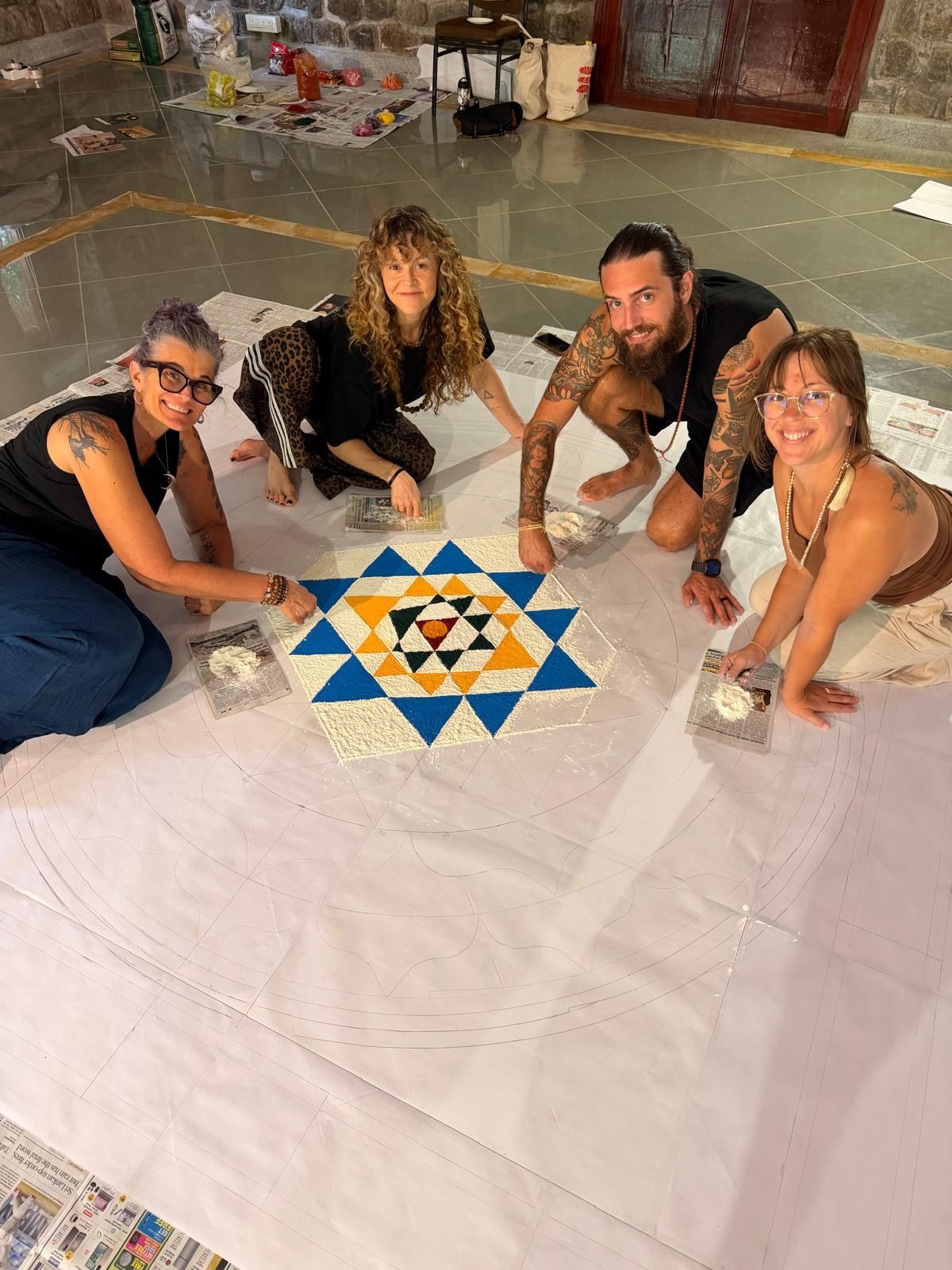
How it started. A small group of us pinching small bits of fine powder into the Sri Yantra pattern. (from left: Kelli, Maureen, Me, and Natalie).

During our Sri Yantra Puja Ceremony (photo by Sara Davis).
At 5pm, our puja started. This was very similar to the puja in Part 1. We gathered around the yantra and chanted mantras together as a group as our pujari Shiva Kumar led the ceremony with chanting, sacred mudras, burning incense, making divine offerings, tossing flowers, spreading holy water, and more. We chanted and sung together for a few hours around the sacred yantra, which is a sacred geometric symbol that represents the cosmos, the Divine Mother, and the merging of divine masculine and feminine energies. As part of this process, our teacher Janet lit a sacred flame and we each wafted the smoke over ourselves to absorb its purifying essence and divine energy. The fragrant smoke acts as a bridge between the physical and the spiritual realms, allowing the devotee to focus their mind and energies on the divine. During a puja, the smoke is considered to carry the devotee’s prayers to the gods.

Our pujari Shiva Kumar illumines his mantra book during our puja ceremony (photo by Sara Davis).
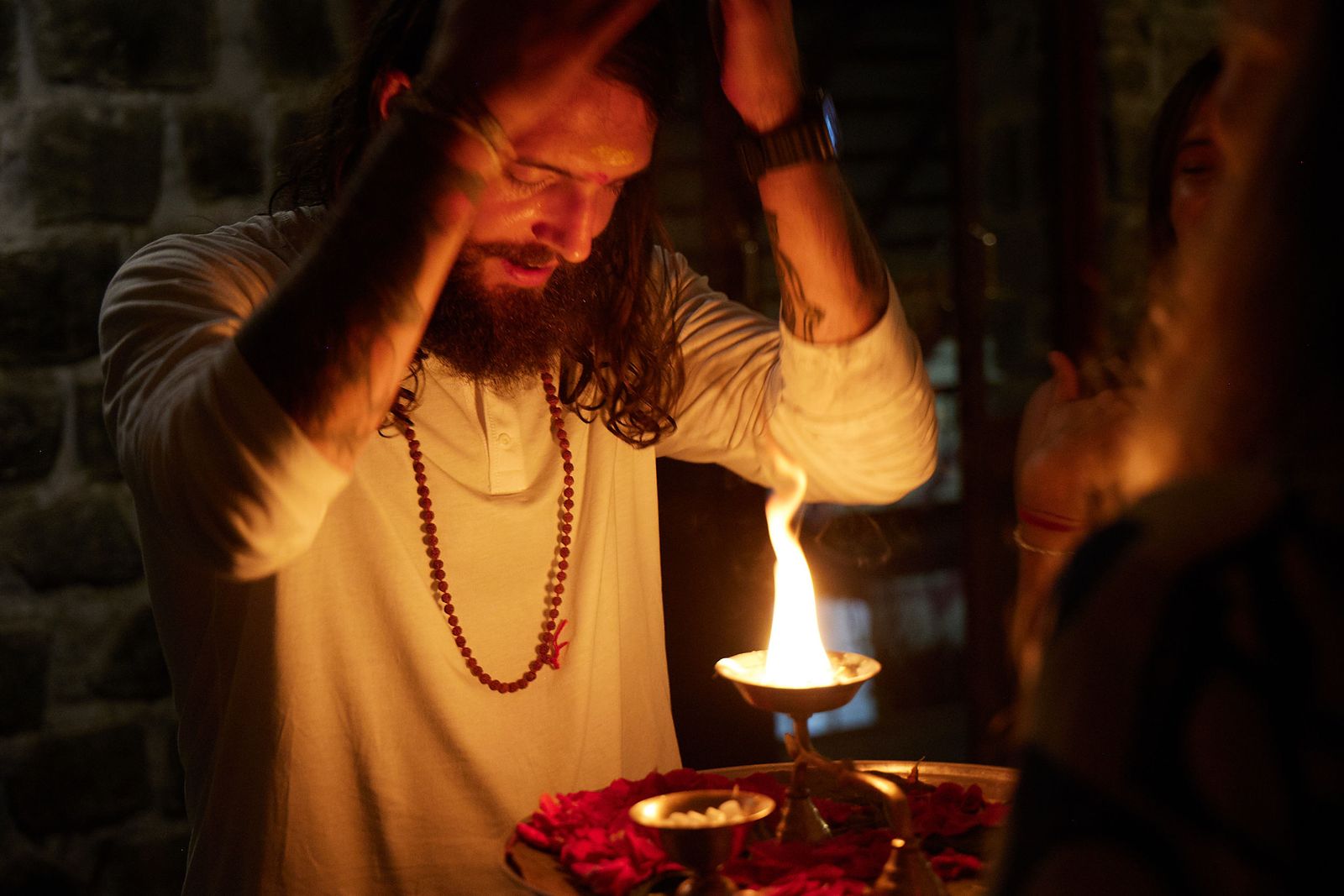
Our teacher Janet offers the sacred smoke (photo by Sara Davis).
The next morning was our last morning in Tiruvannamalai, so we started with a 630am asana practice. Our practice space was on the second floor, surrounded by beautiful trees. We had the windows open to let in the fresh air. At one point during practice, I was in downdog and looked back between my legs. Sitting on the windowsill about two feet behind me was a large monkey - very close to my butt which was up in the air in downdog pose. After being hissed at the other day and hearing about the woman who was bit, I immediately jumped up and the monkey got scared and jumped out the window onto a nearby tree branch. I quickly closed the window and went back to our asana practice. The monkeys weren't done with us though and tried to get in the room a few more times, and some even took a few of our shoes which were on the floor outside the door. Luckily none of the shoes were taken far and we were able to retrieve all of them.
We had a roughly three hour bus ride South to Chidambaram, another small city in Tamil Nadu. We stayed in a very small village about 30 minutes outside of the city. When we arrived at our hotel, there were several women there who were waiting to do henna on us. I had noticed many women with henna tattoos on their hands, arms, and feet. I asked Shiva Kumar if men ever get henna because I hadn't seen that before. He said the men typically get henna on the palms of their hands. Most of our big group got henna tattoos, and each was unique.
 My palms covered in henna.
In the evening, we visited a very small Shiva temple that was just around the corner in the village we were staying in. We brought items such as mala beads, rudraksha seeds, and Ganesh murtis or small statues for the priest to bless. He did a short ceremony with all of our items, taking them back to the deity while chanting mantras and wafting incense. Then we walked outside the small temple room to walk the grounds and pay our respects to the series of small shrines around the temple.
The next day was the last full day of our pilgrimage. We got dressed up in traditional Indian dress, which meant saris for the women and kurtas and dhotis for the men.

We're all dressed up and ready to go. Group pic on the steps of the local Shiva temple (photo by Sara Davis).
After getting a group pic on the steps of the local temple, we headed into town to make our visit to the large Nataraja Temple in Chidambaram. This is another ancient Shiva temple that is associated with the element of Akasha, or Space/Ether. Our teacher Janet has been traveling to this temple for decades, and knew the caretakers of the temple. Once we got to the temple, she introduced us to Selvaganesan, who was the main caretaker. His family has been running the temple for many generations and Janet had known him since he was a young boy. He also introduced us to his young son. Selvaganesan gave us a tour of the temple grounds, explaining the history and significance of the temple as well as pointing out many details. He took us down to the temple water reservoir, throughout many of the buildings, and even up onto the temple roof.

This is the temple water reservoir in the early 1800's. It looks very similar today (Photo from Wikipedia).
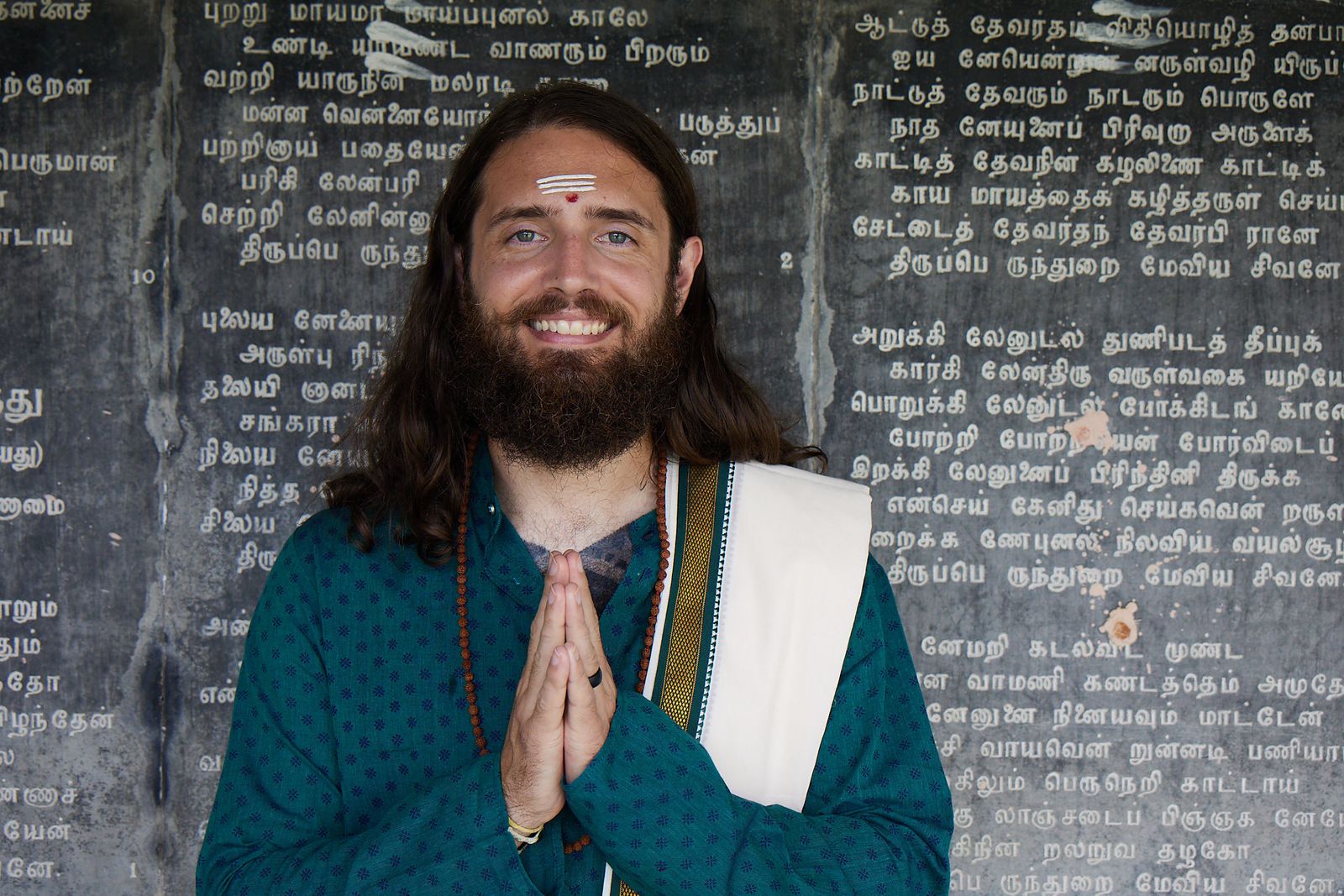
Here I'm standing near the edge of the water reservoir (photo by Sara Davis).
He pointed out the golden roof of one of the buildings, and told us the exact number of golden tiles that represents the average number of breaths that a human will take in a day. He brought our group to take darshan of the deity, Nataraja, who is the dancing form of Shiva. Selvaganesan also explained to us that this temple is the only large and ancient temple in India that is not owned by the government. His family takes on the task of overseeing the temple and keeping the grounds preserved and the daily rituals and services running. Selvaganesan also runs multiple charities, doing things such as supporting children in the area by helping them get school uniforms, backpacks and books, helping the elderly, helping local women, supporting animals and cows, and supporting a network of other ancient temples throughout India. Please see their website and click on "Seva" to read more about the work that they do and to give a donation.

View from the top of temple walls. The golden roof of the Chidambaram Nataraja Temple features 21,600 gold plates, symbolizing the number of breaths a human takes in a day.
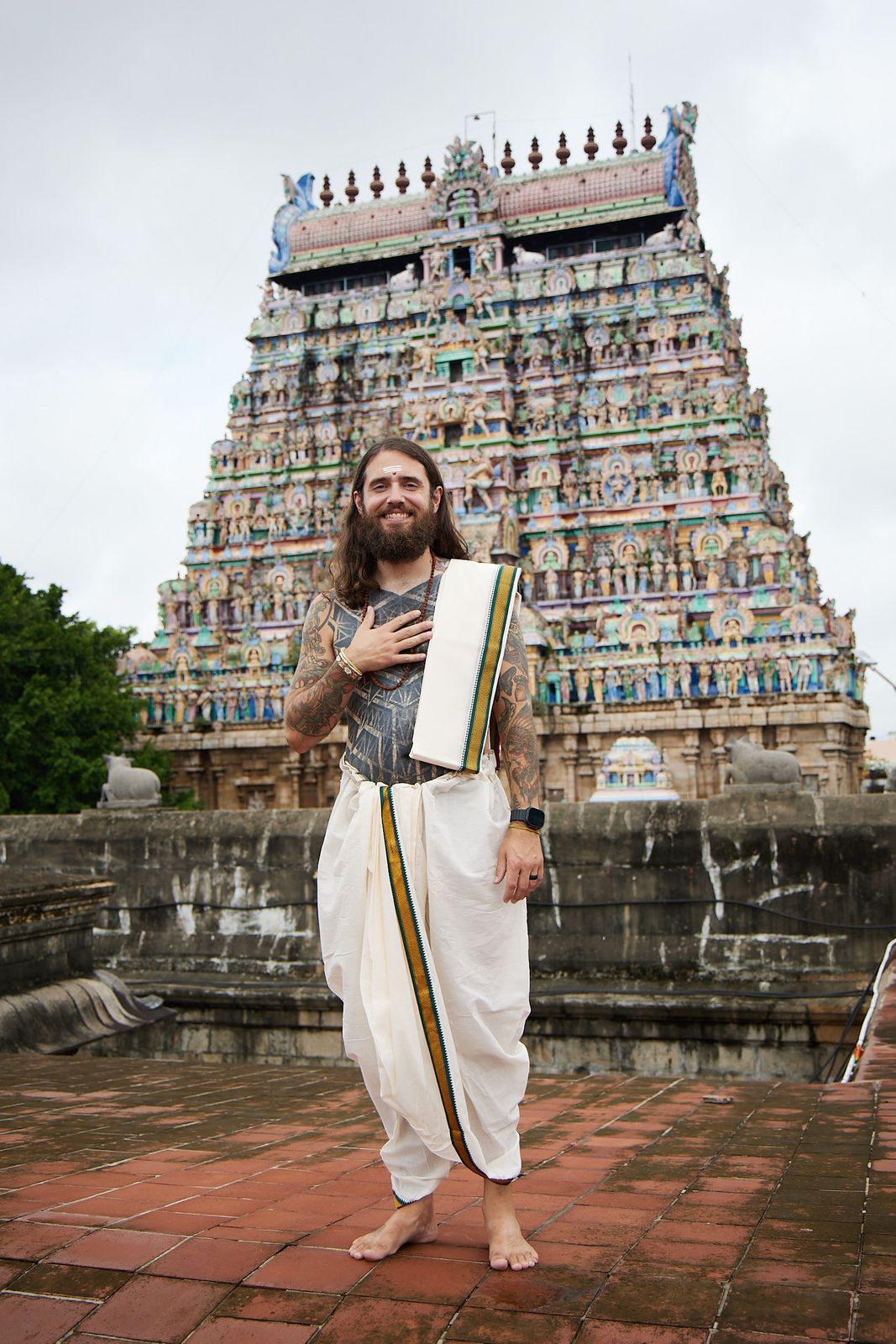
Here I'm standing on the temple roof with one of the large and colorful gopurams behind me (photo by Sara Davis).
A short clip: View from the roof of a colorful gopuram. Notice the man in very bottom right corner offering his prayers.
Seeing this ancient temple and the way that locals and pilgrims were interacting with the space was very inspiring. The love, respect, devotion, and reverence that the people held for the temples and deities was amazing to witness. We saw many families praying together, taking darshan, and absorbing the spiritual atmosphere.

Check out the lotus ceiling at the entrance to the main temple! (photo by Sara Davis)
We were taken to the main temple hall. Before we entered, the men were asked to remove their shirts so that the spiritual energy could more easily enter into our hearts. The priests roped off a central area of the temple for our group, and we were able to take part in a special fire puja ceremony. For this ceremony, 11 priests gathered around us to chant mantras for hours as offerings were made into a giant fire. This ceremony was beautiful, chaotic, and overwhelming. There was so much going on: it was very hot and humid, there were no bathrooms available, the ceremony lasted for roughly 3 hours, 11 priests chanted constantly, massive bells rang, a band loudly played instruments, locals gathered around to see what the foreigners were doing in the ceremony, priests tossed food into the fire and even poured a giant bucket of ghee into a funnel that cascaded into the fire as an offering.

The fire puja in the main temple (photo by Sara Davis)
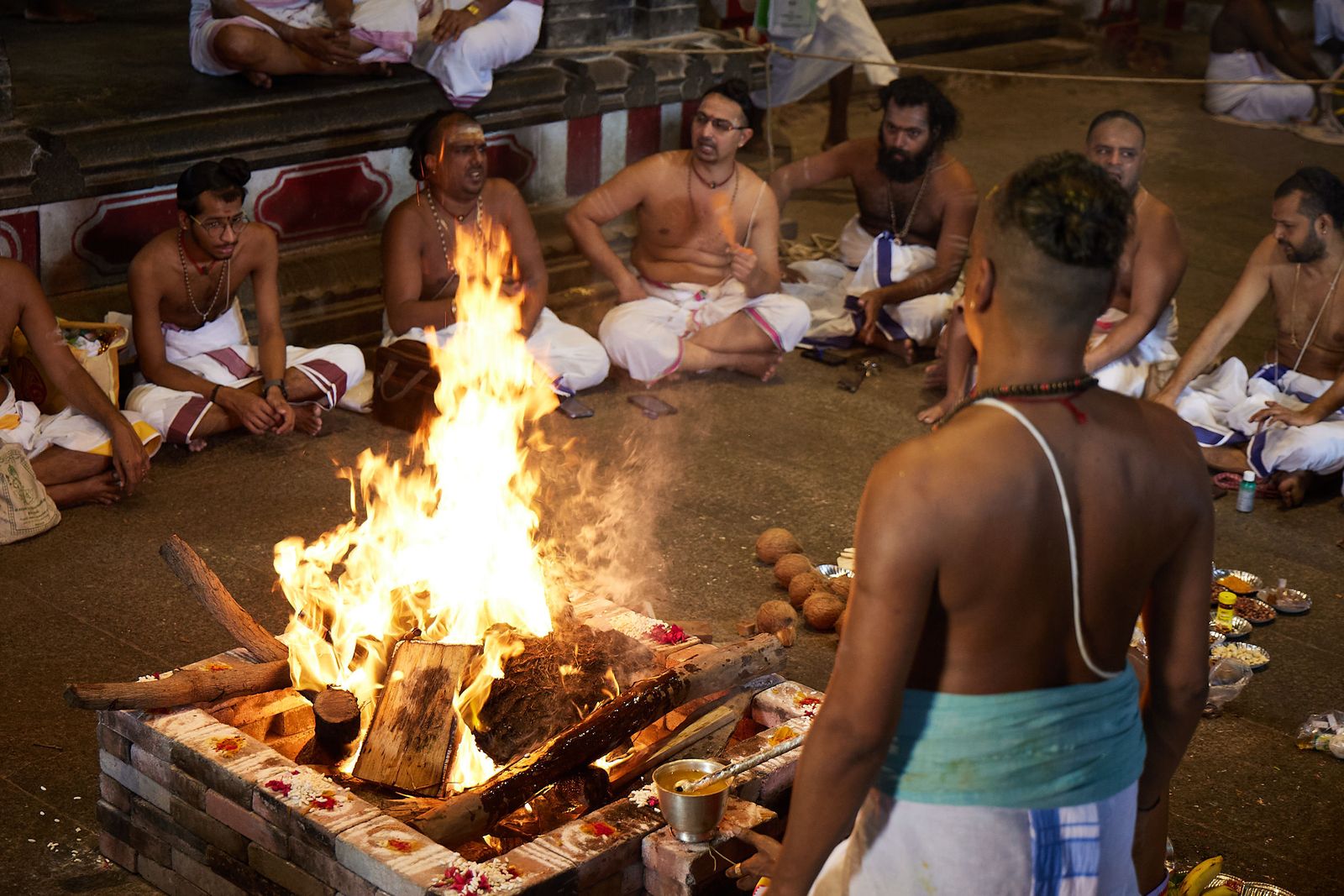
Many priests sitting on the floor, chanting around the fire for hours (photo by Sara Davis)
A short clip: A priest pours ghee into the fire. Chanting can be heard in the background (clip by Sara Davis)
Holy water sprayed, rice was tossed into the air, ghee splattered on the floor, and thick smoke rose from the flames. At one point, I felt something hit my head and assumed it was some rice or something that a priest had tossed...but the woman behind me leaned forward and told me "a bird just shat on your head." Amazing. No bathrooms anywhere in sight, hours to go in our ceremony, it is super hot and humid and I'm only a few feet from a raging fire, and now my head is covered in bird shit. I warned the woman next to me what happened, and she put her hand on my arm to comfort me and told me it was good luck. I was not amused. Maybe 5 minutes later, the bird shits again - this time with the accuracy of a well-trained sniper - and it hits the woman next to me in the forehead. Bird shit splattered from her forehead down onto her face and also onto my shirtless upper body. When I say splattered....I mean it literally covered almost her entire face. I called out to someone that we needed a towel immediately, but no one had a towel. Someone found a dirty newspaper that was crumpled up on the floor and we had to use that to get as much of the shit off of us as we could. Maybe 15 minutes later someone emerged with a few bottles of water and some paper napkins to help us fully clean up. I decided to move out of the bird-sniper's crosshairs, and stood in the only place that was available which was even closer to the blazing fire.
I'm not going to lie...getting shat on twice in these conditions took a bit of the fun out of it for me. But after getting cleaned up and having a few minutes to get back into the ceremony, I was able to relax back into awe and wonder and the incredible scene that I was right in the middle of. It was another reminder that I can't control what happens to me, only how I respond to it. That I didn't come all this way to be comfortable and have all my preferences catered to. That many locals lived permanently in worse conditions than I was currently in. I was here to learn, to experience, to let go of expectations, and to expand my perspectives....even if it meant doing it while sweating next to a blazing fire, covered in shit, with priests chanting around me. Later on at the end of our trip as I was saying goodbye to the other woman that was shat on, I told her "we will always remember that time we got shitfaced together in India."
A short clip: A band with two horn players and a drummer plays inside the temple (clip by Sara Davis)
Each member of our group had a different experience with this ceremony, from awe to ecstasy to confusion to exhaustion to extreme overwhelm, and probably a lot of other feelings as well. After the ceremony ended, we got a chance to serve prasad, or sacred food, to some of the locals before we left the temple. After a very long day at the temple, we headed back to the hotel to get cleaned up and have a final asana practice and discussion with the group.
The next day, the group split up to go in several different directions. I was with a smaller group that was headed back to Chennai for Diwali, or the festival of lights. We had an all-day bus ride back to Chennai, and then a final few days in India for the festival. Diwali is an amazing festival where the locals shoot fireworks nonstop for days at time. I have never in my life seen fireworks like this, especially not so close to buildings.
A short clip: Fireworks in Chennai during Diwali. This was happening in every direction for days without stopping.
At the beginning of my India trip, I had a lot of anxiety about the crowds and the noise and the food and the vaccine shots and the water quality and the mosquito-borne illnesses. Getting through the trip gave me a new confidence that I can handle whatever comes my way. At the same time, I learned that I always need to be prepared and take necessary precautions to protect myself. Multiple people in our group got sick throughout the trip, and a small handful of them even needed to be hospitalized. One person was hospitalized for severe food poisoning, and another got Dengue Fever from mosquito bites and spent several days in a rural Indian hospital. Thankfully they were both able recover.
In all my traveling, I have never done a trip like this. For me, India was a case of extremes. Beautiful mountains as well as heaps of burning garbage. Ornate golden palaces as well as tent cities. Fragrant aromas and disgusting smells. Spiritual experiences and absurd situations. Extremely friendly and welcoming people as well as massive crowds pushing and cutting lines. Meditating in remote caves and getting literally shat on in ancient temples.
I met some of the most interesting and amazing people ever on this trip, from locals to teachers to fellow yogi pilgrims, that are still continuing to inspire me today.
Coming home was almost as much culture shock as going to India was. The places and people of home are the same, but somehow I am changed. I will never forget this series of amazing experiences... the highs and lows, the spiritual and the mundane, the inner and outer pilgrimages.
As I try to integrate back into my life at home, I'm left trying to keep alive my sense of wonder, awe, mystery, adventure, and devotion. Some days I feel myself slipping back into old patterns and routines, missing all of these qualities. Other days I am transported right back into the Mystery of it all, able to feel reverence and connection.
One thing is for sure, I will never forget this adventure.
Want to find out if private sessions will work for you? Want to explore working with me in another capacity? Book a free consultation call with me. I offer private sessions both online and in my home studio in Raleigh, NC.
Max Baker | DEC 29, 2025
Share this blog post
 OfferingTree